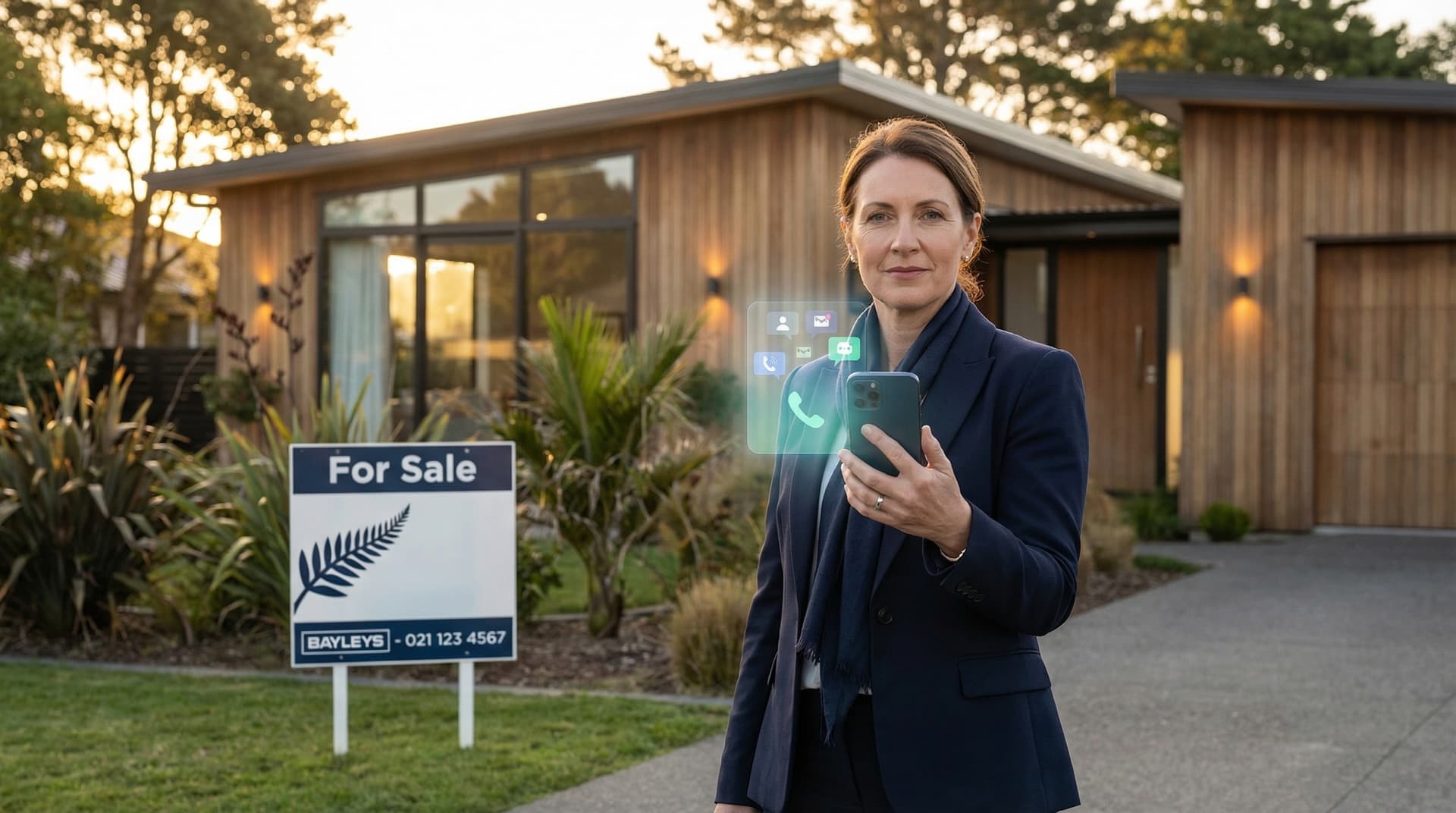
You are standing in a lounge in Ponsonby, halfway through a listing appraisal, when your phone buzzes. A buyer. You cannot answer because the vendor is mid-sentence about their renovation timeline. By the time you call back 40 minutes later, the buyer has already spoken with two other agents and booked viewings with both. That listing enquiry is gone.
This scenario plays out hundreds of times a day across New Zealand real estate. I have built voice AI systems for NZ property management that solve exactly this problem. The same architecture works for real estate sales, and the financial case is even stronger.
Why do NZ real estate agents lose clients to missed calls?
Real estate in New Zealand runs on first-response advantage. Buyers and vendors contact multiple agents simultaneously. The agent who answers, qualifies, and responds first wins the conversation. Voice AI for real estate agents in NZ ensures every call is answered, 24 hours a day, whether the agent is on an appraisal, running an open home, or driving between properties.
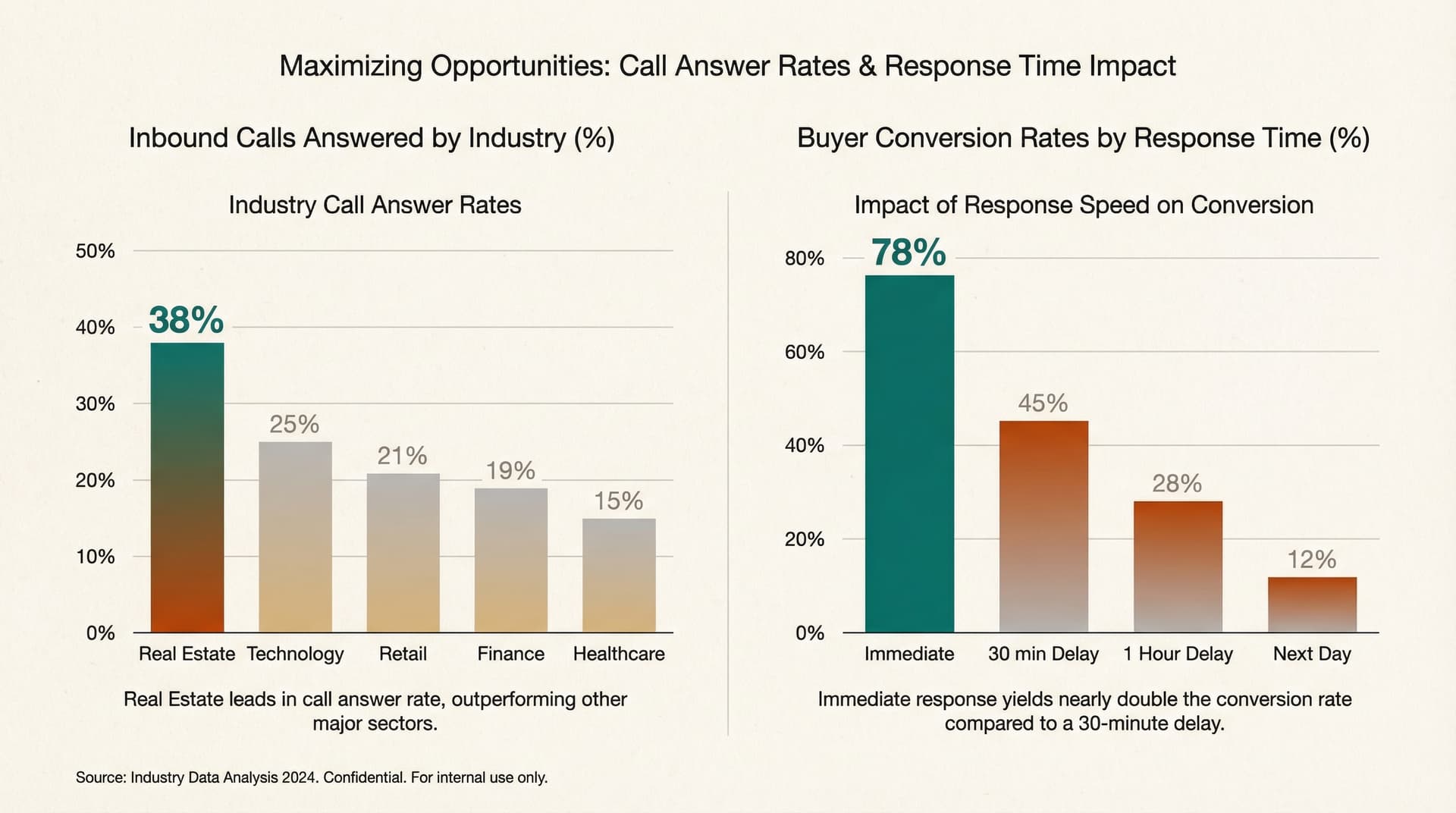
The numbers are stark. Research consistently shows that 27 to 62 percent of inbound calls to service businesses go unanswered. Real estate sits at the worse end of that range because agents spend most of their working hours away from a desk. Open homes, listing presentations, buyer viewings, auctions — the core revenue-generating activities all require being physically present and unavailable by phone.
The compounding problem is that real estate callers do not leave voicemails. Roughly 80 percent of people who reach voicemail hang up without leaving a message. They do not try again either. A RAIN Group study found that 85 percent of callers who fail to reach someone on the first attempt will not call back. In real estate, where the next agent is a Google search away, that caller is already dialling someone else.
Unlike trades or professional services, where a customer might wait a day for a callback, real estate operates on emotional momentum. A vendor who decides to sell on a Tuesday evening wants to talk to someone now. A buyer who spots a listing on Trade Me at 9pm wants to book a viewing before the weekend. Delay kills intent.
What does a typical missed-call scenario cost a real estate agent?
A single missed listing in New Zealand carries an average commission value of $15,000 to $25,000 at current market rates. When buyers call multiple agencies simultaneously, the first agent to respond sets the relationship. The financial case for voice AI in real estate is not marginal. It is structural.
Work through the numbers. The median house price in New Zealand sits around $800,000 as of early 2026. At a standard commission rate of 2.5 to 3.5 percent on the first $400,000 and 2 percent thereafter, the average residential commission lands between $14,000 and $22,000. For an agent working 15 to 20 active listings per year, missing just one listing appraisal call per quarter means $60,000 to $88,000 in lost annual gross commission income.
That is the vendor side. On the buyer side, a missed call from a qualified buyer ready to make an offer can delay or lose a sale entirely. If the buyer speaks with a competing agent who shows them a comparable property first, your vendor loses their best offer and you lose your commission on that transaction.
I walk agents through these numbers regularly. The response is almost always the same: "I knew missed calls were a problem, but I had not quantified it." The gap between intuition and arithmetic is where voice AI earns its place.
How does voice AI actually work during a busy open home weekend?
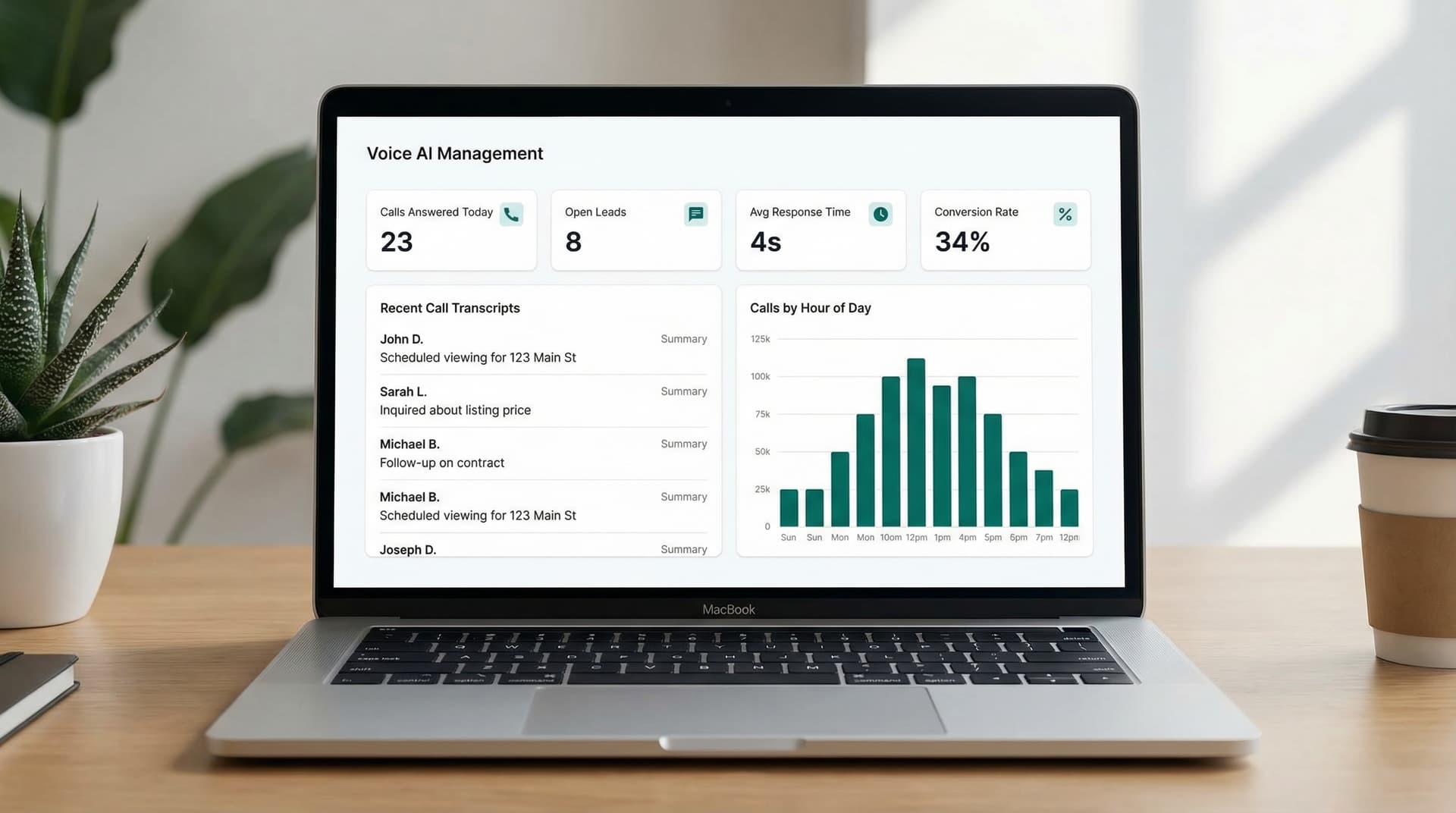
Voice AI for real estate works by answering every inbound call on the agent's existing mobile or office number, conducting a natural conversation to understand what the caller needs, capturing their details and intent, and routing urgent calls or delivering structured summaries. The agent returns from an open home to a complete log of every enquiry, qualified and prioritised.
Here is a Saturday afternoon. You are running an open home in Mount Eden with 25 groups walking through over 45 minutes. Your phone is in your pocket. During that window, four calls come in: a buyer asking about a different listing, a vendor wanting to book an appraisal, a tenant from a managed property with a maintenance issue, and a cold call from a marketing company.
Without voice AI, all four hit voicemail. Maybe one leaves a message. The vendor calls another agent.
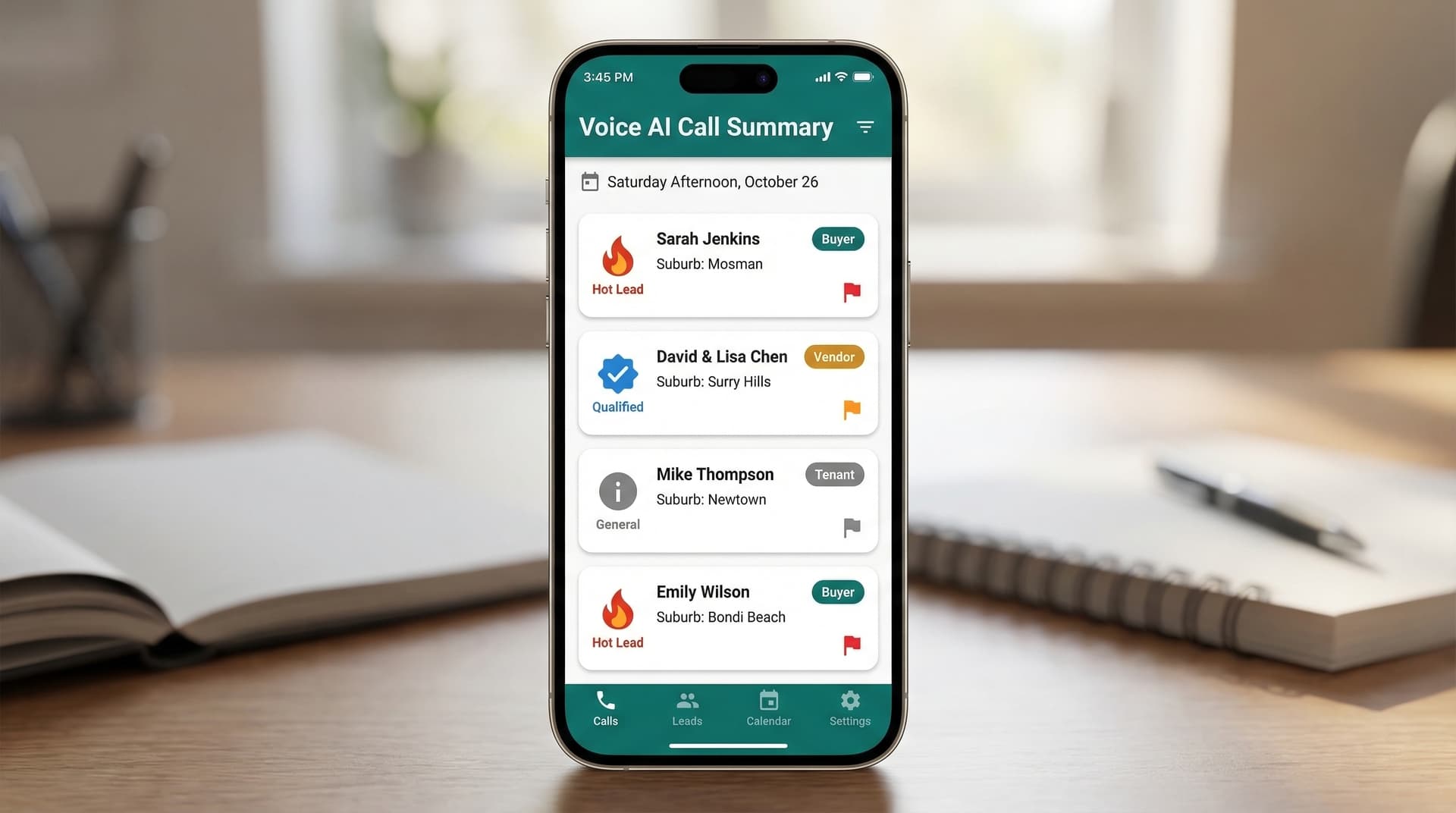
With voice AI, each call is answered. The system conducts a brief, natural conversation. It asks the buyer which property they are enquiring about, their timeframe, and whether they have finance arranged. It asks the vendor about their property, when they are considering selling, and what prompted the call. It classifies the tenant call and routes it appropriately. It politely ends the marketing call.
When you finish the open home, you check your phone. Four structured summaries are waiting: caller name, phone number, enquiry type, qualification details, and a priority flag. The vendor who wants to list is marked urgent. You call them back within 10 minutes. They are impressed by the speed. You win the appraisal.
Can voice AI qualify leads the way a human receptionist can?
Modern voice AI qualifies real estate leads by asking structured questions about timeframe, finance pre-approval, property type, and location preferences. This is not scripted IVR. It is a conversational system that adapts to what the caller says, extracting the information agents need to prioritise follow-up without a human picking up the phone.
The natural objection is "real estate is a relationship business and my clients will not talk to a robot." I hear this regularly. The data tells a different story. Callers care about two things: that someone answers and that their enquiry is handled competently. A voice AI that picks up, asks sensible questions, and confirms it will pass details to the agent creates a better first impression than a voicemail box that nobody checks until Monday.
The AI is not building the relationship. It is keeping the door open until the agent can. There is a meaningful difference between a caller who reaches voicemail and moves on, and a caller who has a brief conversation, provides their details, and expects a callback. The second caller is already in your pipeline.
What happens with after-hours enquiries from buyers and vendors?
After-hours enquiries represent some of the highest-intent contacts a real estate agent receives. A vendor who decides to sell on a Sunday evening and calls that night is ready to act. Voice AI ensures those calls are answered, captured, and queued for immediate Monday morning follow-up before the vendor calls a competitor.
The decision to sell a home is rarely made during business hours. It happens over dinner, during a weekend conversation, after a life event. The vendor picks up the phone when the decision is fresh. If they reach voicemail at 8pm on a Sunday, by Monday morning the urgency has either faded or been captured by another agent who happened to answer.
Buyer enquiries follow a similar pattern. Trade Me and realestate.co.nz traffic peaks in the evening. A buyer browsing listings at who f9pminds a property they want to see calls the listed agent. That call, if answered and qualified by voice AI, becomes a confirmed viewing for the weekend. If missed, it becomes someone else's viewing.
How does voice AI compare to a receptionist or VA for real estate agents?
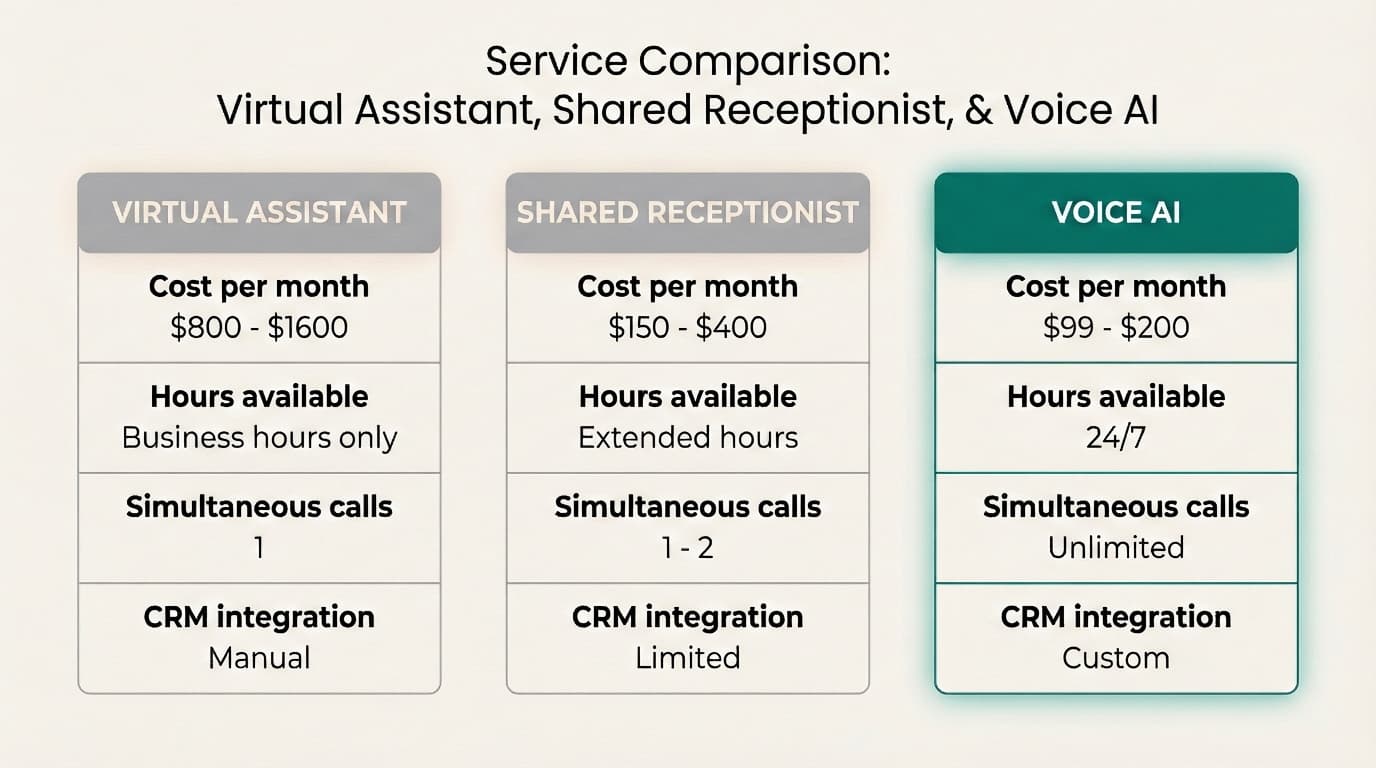
Voice AI for real estate differs from a virtual assistant or shared receptionist in three critical ways: it is available instantly at any hour, it scales to simultaneous calls during peak periods like open home weekends, and it captures structured data rather than message slips. For NZ agents managing 20 to 40 active enquiries, a VA cannot provide this coverage at a comparable cost.
A virtual assistant costs $25 to $40 per hour, works business hours only, and handles one call at a time. They are warm and personal, but unavailable at 9pm on a Saturday, perhaps when your best leads are calling.
A shared receptionist service runs $150 to $400 per month, offers extended but not 24/7 hours, and the person answering may not know your listings, your market, or your preferred qualification questions. Quality varies depending on who picks up.
Voice AI runs $99 to $200 per month, operates around the clock, handles unlimited simultaneous calls, and captures structured data in a consistent format every time. It does not replace the human relationship. It covers the gaps where no human is available.
The honest assessment: for complex vendor conversations where empathy and negotiation matter, a human is better. For the 80 percent of inbound calls that are initial enquiries needing capture and qualification, voice AI is faster, cheaper, and more reliable than any alternative. Integrating voice AI with existing NZ business systems is straightforward when the system is built for it.
What should a NZ real estate agent look for when choosing voice AI?
The key factors for NZ real estate agents choosing voice AI are New Zealand English performance, CRM integration capability, call recording and transcript access, and whether the system handles property-specific qualification questions. Generic voice AI built for retail or hospitality will underperform in a real estate context.
Five things to check before signing up:
NZ accent and place name accuracy. This is non-negotiable. A system that mispronounces Paraparaumu, stumbles on Ngaio, or cannot parse a Manawatu address will lose caller confidence immediately. Test with local suburb names before committing.
CRM integration. If you use Rex, Console Cloud, PropertyMe, or Re/Leased, with some additional development, the voice AI can feed qualified leads directly into your existing pipeline.
Transcript and recording access. For compliance, follow-up accuracy, and training purposes, you need full call transcripts and recordings. Any system that only provides summaries without the underlying data is a limitation you will hit quickly.
Configurable qualification flows. The questions that qualify a first-home buyer in Christchurch are different from those for an investor in Auckland. The system should allow you to define what it asks and how it prioritises.
Buyer versus vendor distinction. The most useful voice AI systems classify callers by intent. A vendor enquiry has different urgency and follow-up requirements than a buyer enquiry. The system should route and flag accordingly.
For choosing the right AI partner more broadly, the same principles apply: look for production systems, not demos.
Can voice AI help property managers as well as sales agents?
Property managers in New Zealand face the same after-hours call problem as real estate sales agents, with the added complexity of urgent maintenance requests and tenant emergencies. I have built voice AI systems specifically for NZ property management. The same architecture applies, with classification logic trained on maintenance triage rather than buyer qualification.
I built exactly this for Brenda Currie Property Management in Palmerston North. Their system, Liam, handles after-hours tenant calls across 180 properties, classifies urgency, provides safety guidance, and dispatches contractors automatically. The full case study is worth reading if you manage a mixed portfolio of sales listings and rental properties. The underlying voice AI architecture transfers directly. What changes is the classification logic: instead of "buyer or vendor, what suburb, what timeframe," the property management layer asks "what is the issue, is there a safety risk, which property, which contractor category."
For agencies that handle both sales and property management, a single voice AI system can route calls to the correct workflow based on caller intent. One number, two classification trees, zero missed calls.
What does it cost to implement voice AI for a NZ real estate agency?
Voice AI implementation for a NZ real estate agency ranges from off-the-shelf SaaS products at $50 to $200 per month to bespoke systems at a one-off build cost plus monthly operating fees. The right choice depends on team size, call volume, CRM requirements, and whether a generic system meets your qualification needs.
For a solo agent or a team of two to three, an off-the-shelf voice AI product configured for real estate qualification handles the basics well. You get 24/7 call answering, basic qualification, and call summaries delivered by SMS or email.
For agencies with five or more agents, specific CRM integration requirements, or complex multi-branch routing needs, a bespoke build makes more sense. The upfront cost is higher, but the system is built around your exact workflow rather than forcing your workflow into someone else's template.
The ROI calculation is simple. If voice AI captures one additional listing per quarter that would otherwise have been lost to a missed call, the system pays for itself many times over. At $15,000 to $25,000 per listing commission, even a $5,000 annual investment in voice AI needs to recover only a fraction of one deal to justify the cost.
If you want to scope what voice AI would look like for your agency, get in touch. I offer a fixed-fee discovery phase that maps your call patterns, identifies the gaps, and recommends the right approach — whether that is an off-the-shelf product or a bespoke build through EmbedAI's integration services.
Frequently asked questions
- Does voice AI work with New Zealand accents and place names in real estate?
Modern voice AI trained on NZ English handles local place names, Maori terminology, and regional accents reliably. Systems built on speech recognition engines tested against NZ English handle suburbs like Paraparaumu, Pakuranga, and Whanganui accurately. Always test the system with local place names before committing to a deployment.
- Can voice AI integrate with real estate CRM platforms used in New Zealand?
Integration with CRM platforms like Rex, Console Cloud, and PropertyMe is possible via API, though it depends on the system you choose. Bespoke voice AI implementations include CRM integration as a core deliverable. Off-the-shelf products may require middleware or manual export of call transcripts.
- Will real estate clients know they are talking to an AI?
Some will ask directly, and any ethical system will confirm it is AI when asked. In practice, callers care more about whether their enquiry is handled competently than whether they are speaking with a human. A well-built voice AI that answers promptly, asks sensible questions, and captures details accurately creates a better first impression than voicemail.
- How quickly can a real estate agent set up voice AI?
Off-the-shelf voice AI products can be configured and live within 24 to 48 hours. Bespoke systems with CRM integration and custom qualification flows typically take two to four weeks from scoping to deployment. The setup involves configuring the agent's existing phone number to route through the AI system, with no hardware changes required.
- Is voice AI suitable for a solo agent as well as a larger agency?
A solo agent benefits from voice AI covering calls during open homes, appraisals, and evenings without the overhead of a receptionist or VA. Agencies with multiple agents use it for consistent after-hours coverage and lead qualification at scale. The monthly cost is justified at a single additional listing captured per quarter.