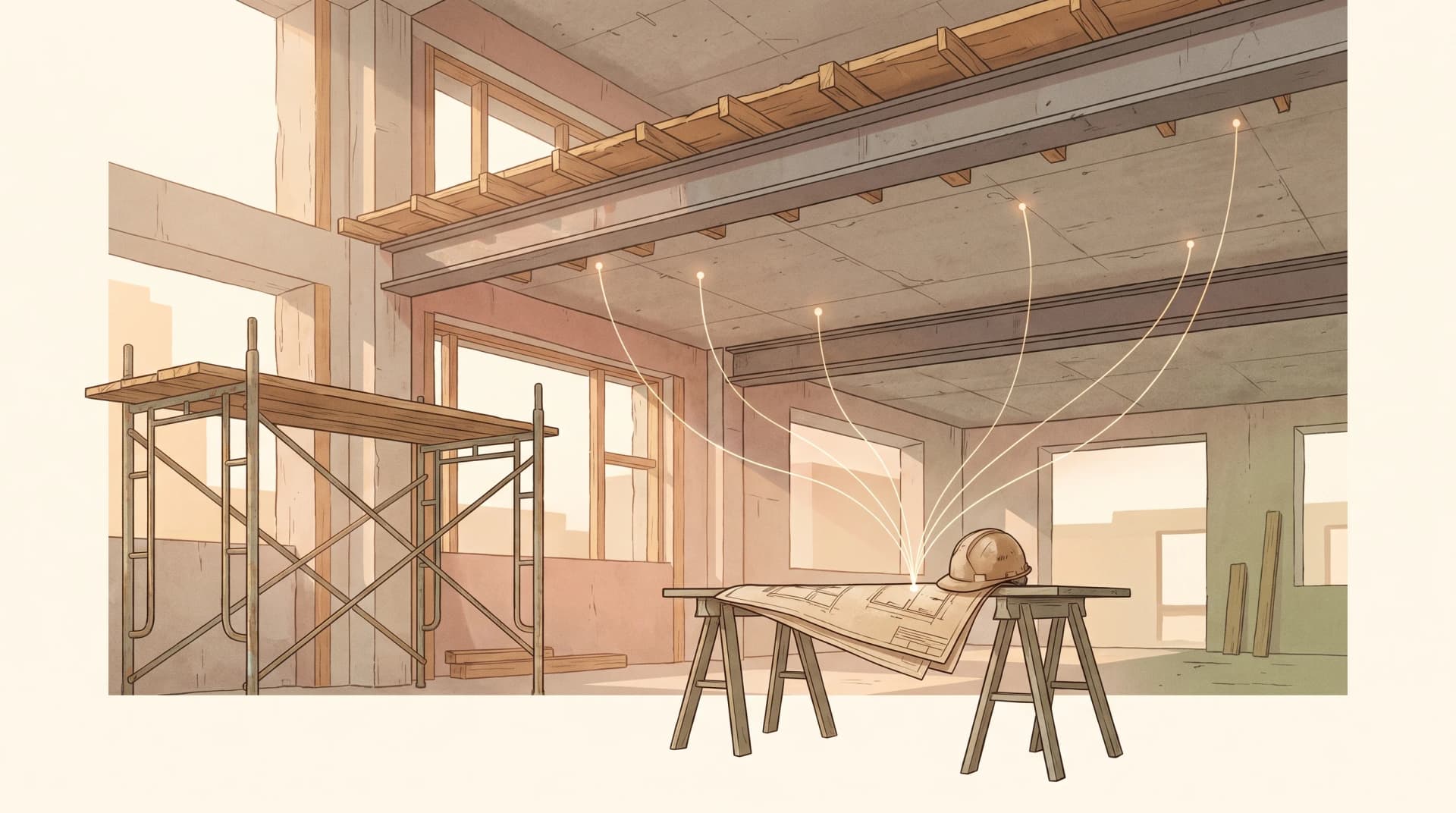
The New Dunedin Hospital Outpatients Project did not get less complex by adding a robot. It got safer. Southbase Construction deployed the Hilti Jaibot, a semi-autonomous drilling robot fed coordinates from the BIM model, to drill roughly 40,000 holes into concrete ceilings for seismic supports. Every one of those holes used to be drilled by a tradesperson on a scissor lift with a tool above their head, an arrangement that turned a routine workday into a slow grind on shoulders, necks, and lower backs.
That story matters for two reasons. The first is the obvious one: a hazardous task has been mechanically removed from the hands of humans. The second is less obvious. In the same period, NZ manufacturers have begun running agentic AI across their supply chains, and Construction Health and Safety New Zealand has launched an AI digital workmate to reduce the soft-tissue injuries that quietly dominate ACC claims. Construction and manufacturing are leading NZ adoption in the unglamorous places that actually move outcomes, and the rest of the economy is still catching up.
What does AI on a NZ construction site actually look like in 2026?
AI on a NZ construction site in 2026 sits in three layers: physical robotics handling hazardous repetitive tasks under BIM coordination, AI-augmented site capture tools producing daily progress data, and AI-driven digital workmates supporting trades on safety, planning, and compliance. The scaffolding around all three is the BIM model, which is increasingly machine-readable from end to end.
The physical robotics layer is the most visible piece. The Jaibot at New Dunedin is one example, but the same pattern is appearing on layout marking, overhead duct installation, and rebar mapping. Each task has the same shape: a clearly defined geometry, a hazardous or punishing physical envelope, and a specification that already lives in a digital model. AI reads the model. The robot acts on the model. A trades worker supervises rather than performs.
The site capture layer is quieter but more pervasive. Tools such as OpenSpace stitch site walks into navigable digital twins that the project team can interrogate against the BIM model. AI does the comparison automatically: where the build deviates from the model, what was completed today, where defects are clustering. Southbase reported that integration of spatial AI on the Outpatients Project contributed to a 20% overall reduction in quality assessment time across the construction management team. That is not a futurist claim. That is hours coming back to a project manager every week.
The digital workmate layer is the newest. It is the one most likely to reach NZ trades businesses outside the top-tier projects, because it does not require BIM, robotics, or capital expenditure. A worker with a phone and an app can get the benefit of structured, evidence-based AI guidance on a job they would otherwise figure out alone.
How is AI changing construction safety in NZ?
AI is changing NZ construction safety by moving the point of intervention from after-incident reporting to before-task triage. CHASNZ's PainPal, launched in late 2025, gives tradespeople instant ergonomic guidance for the task they are about to perform, aiming squarely at the soft-tissue injuries that account for 55% of NZ workplace injury claims and cost ACC over $6,300 per lower-back claim alone.
The shape of the problem is well understood. Lower-back, shoulder, and knee injuries do not come from a single dramatic event. They come from years of repetitive loading, awkward postures, and small daily decisions made by people who are too busy or too proud to slow down. Traditional H&S programmes catch them at the end of that arc, when a worker is filing an ACC claim. PainPal sits at the start of it, on a phone, asking what the worker is about to do, then offering specific guidance that is tied to that task rather than to a generic poster on a smoko room wall.
The mechanical effect is the same as the Jaibot's effect on overhead drilling, just delivered through a different tool. The hazardous portion of the work is moved out of human hands when it can be, and where it cannot, the human gets better information about how to do it without breaking themselves. NZ businesses operating in trades or building services can lean on this same logic when looking at their own site practices, and the trades and SME industry view walks through how the same patterns play out in smaller field-service operations.
Why are NZ manufacturers adopting agentic AI for supply chains?
NZ manufacturers are adopting agentic AI for supply chains because the next disruption is always closer than the last one, and human teams cannot watch enough variables fast enough to respond well. Agentic systems now reroute deliveries dynamically, manage warehouse inventory through digital twins, and flag logistical bottlenecks with minimal human intervention, while humans hold the boundaries on material decisions.
The driver is geopolitical and climatic volatility, not technology fashion. NZ manufacturers exporting into volatile markets, or importing components through volatile lanes, are increasingly adopting "local-for-local" resilience models that shorten supply chains and produce closer to demand centres. AI-enabled insight is the layer that makes those models viable. Without AI, the local-for-local design produces too many small decisions for a planning team to track. With AI, the small decisions are made automatically inside guardrails, and the planning team handles the exceptions.
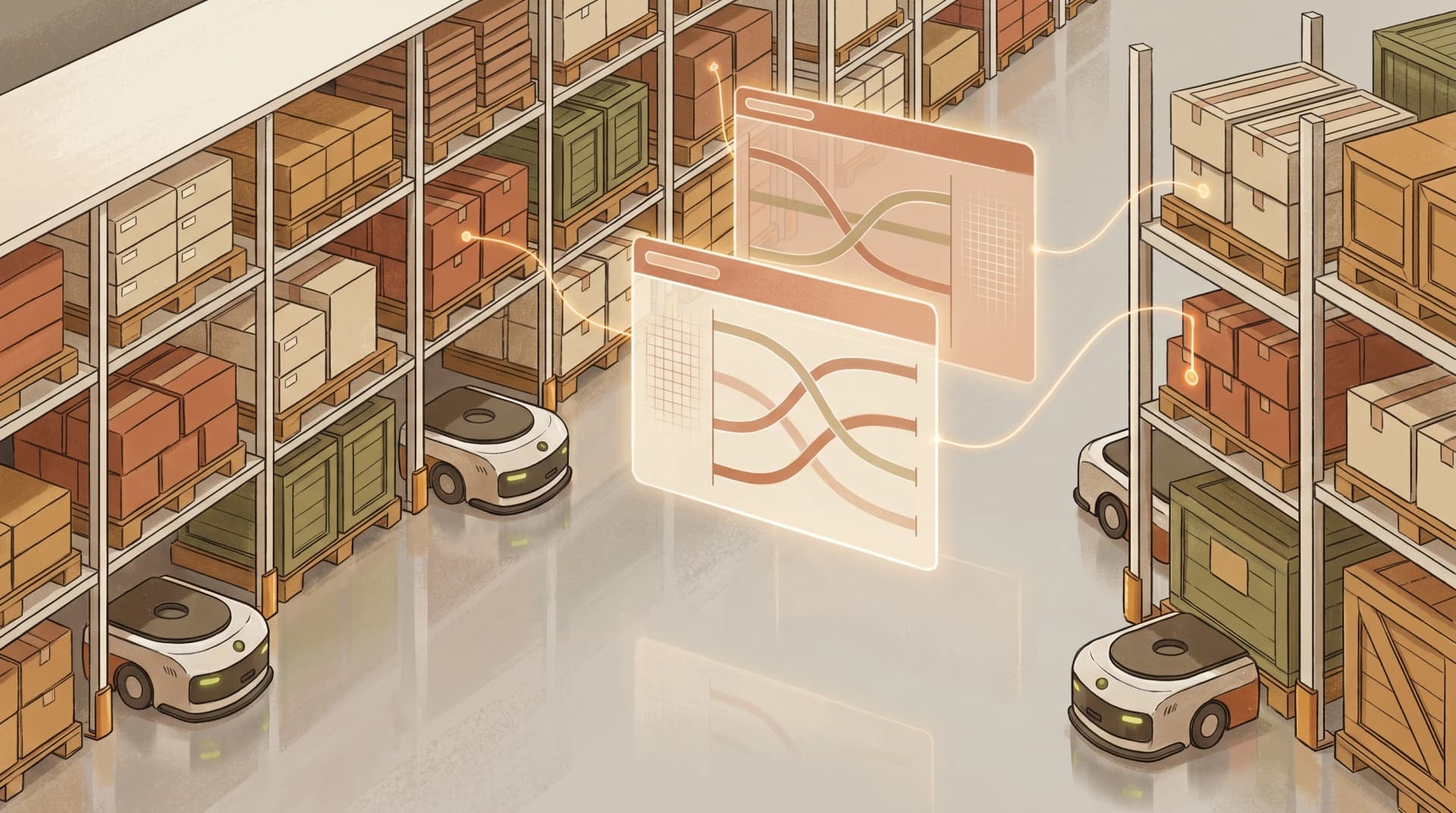
The risk in agentic systems is well known and worth naming. An agent that can act without supervision can also act wrongly without supervision. NZ manufacturers running these systems well wire in three things consistently: explicit thresholds above which a human must approve, full audit logs of every agent decision, and a clean override path that is not buried four screens deep in a vendor product. Manufacturers that skip those guardrails do see the productivity wins, briefly, before they see the first incident that consumes a week of senior time to unwind.
How does BIM-plus-AI reshape quality assurance and project management?
BIM-plus-AI on a NZ construction project compresses the time spent on quality assessment and progress reporting by automating the comparison between the model and the build. Southbase reported a 20% overall reduction in quality assessment time on the New Dunedin Hospital Outpatients Project once spatial AI was layered onto its existing BIM workflow.
The mechanics are straightforward in description and demanding in execution. A site walker captures the build state on a 360-degree camera. The capture is uploaded and aligned to the BIM model automatically. Differences between model and build are surfaced as a list, ranked by area, trade, or risk. The project manager opens the list rather than walking the site to find the issues themselves. The site walk still happens. It just no longer carries the entire weight of detection.
The pattern that holds in well-run deployments is the same pattern we see across all three layers in this post. AI is not replacing the trade or the engineer or the project manager. It is taking the highest-volume, lowest-judgment portion of their work and handing it back to them as a structured queue. The work that demands judgment, including how to sequence remediation, who to escalate to, when a defect is acceptable, stays squarely with humans. Where projects have tried to push the judgment portion onto the AI, the result has consistently been worse than the human-only baseline.
What does this mean for headcount across NZ construction and manufacturing trades?
Across NZ construction and manufacturing, AI is shifting work rather than removing workers. Site-based trades are not being replaced by robots, but workers are being moved away from the most hazardous and repetitive portions of their day. Back-office auditing and compliance roles are absorbing more output without expanding headcount. Manufacturing planning teams stay the same size while running far more sophisticated networks.
The honest framing matters because a misread of the data leads to bad decisions on both sides. Workers reading the headlines as a layoff signal disengage from training programmes that would otherwise put them in better positions. Operators reading the headlines as a chance to cut crews end up understaffed when the AI fails on the part of the job nobody documented. Neither pattern is happening at scale in NZ construction or manufacturing. What is happening, consistently, is that automation is converting into business value without expanding back-office administrative headcount, and physical trades work is becoming safer and slightly less physically punishing for the people doing it.
This piece is part of a wider series on the state of AI in NZ business across 2025 and 2026. For NZ trades and SME operators looking at how these patterns scale down to smaller sites and crews, our trades and SME industry view covers the operational fundamentals.
Frequently asked questions
- Can AI robots replace tradies on a NZ construction site?
AI-driven robotics are taking over specific, repetitive, and hazardous tasks on NZ sites, but they are not replacing tradespeople. Drilling tens of thousands of overhead holes, repetitive layout marking, and routine inspections sit comfortably inside the robot envelope. Skilled trades work involving judgment, problem-solving, and customer-facing decisions stays with humans. The shift is best understood as removing the most dangerous and physically punishing portions of a tradie's day, not removing the tradie.
- What is the Hilti Jaibot, and why was it used at New Dunedin Hospital?
The Hilti Jaibot is a semi-autonomous drilling robot that takes coordinates from a Building Information Modelling file and drills the marked holes into concrete ceilings without a worker operating at height. Southbase Construction used the Jaibot during the New Dunedin Hospital Outpatients Project to drill approximately 40,000 holes for seismic supports, removing the most hazardous portion of that scope from human workers entirely while keeping pace with the wider programme.
- How does CHASNZ's PainPal differ from a normal H&S app?
Most workplace H&S apps log incidents after they happen. PainPal, launched by CHASNZ in late 2025, sits a step earlier: it gives tradespeople instant, evidence-backed ergonomic guidance for the specific task they are about to perform. The aim is to prevent the soft-tissue strains that account for 55% of NZ workplace injury claims and cost ACC over $6,300 per lower-back claim. It is triage at the start of the day rather than a logbook at the end of it.
- Will agentic AI break NZ manufacturing supply chains?
Agentic AI is more likely to harden NZ manufacturing supply chains than break them, provided humans hold the boundaries. NZ manufacturers using agentic systems to reroute deliveries, manage warehouse digital twins, and surface logistical bottlenecks report better resilience to weather and geopolitical disruption. The risk is not the technology itself but unbounded autonomy. Operators that wire in clear approval thresholds, audit logs, and human override on material decisions get the upside without the tail risk.